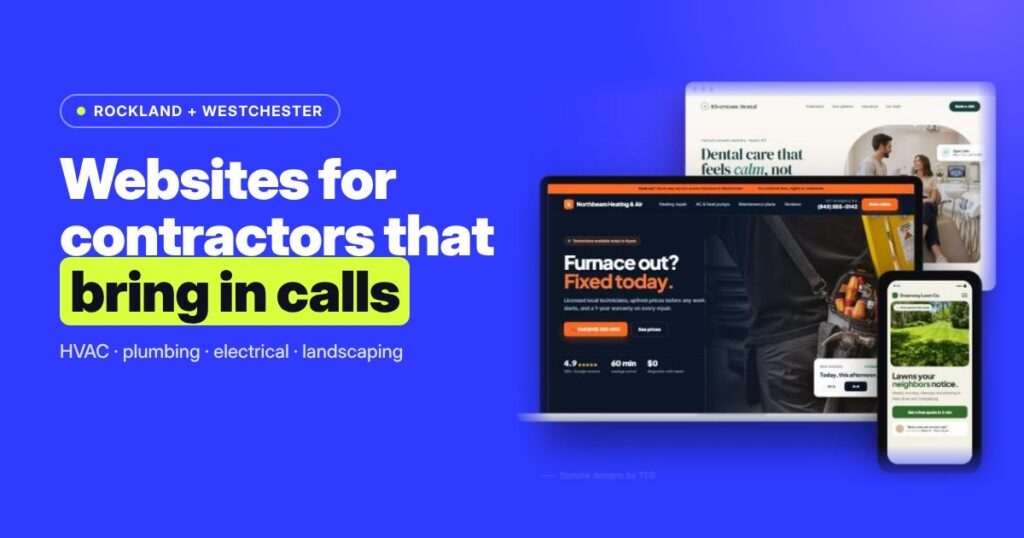
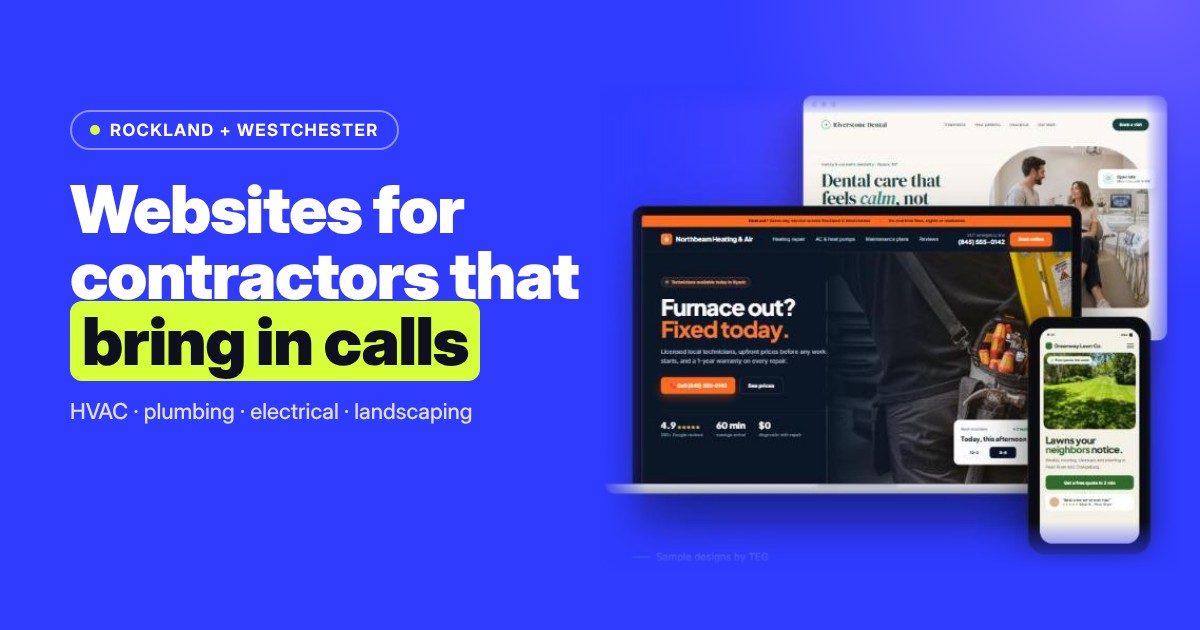
Website design for contractors and home service businesses comes down to one job: turning a stranger on a phone into a phone call. If you run an HVAC, plumbing, electrical, roofing or landscaping company in Rockland or Westchester, your website has a few seconds to show what you do, which towns you cover and why you can be trusted, then make it easy to call. This guide to contractor website design covers the pages, features and setup that actually bring in jobs, what it costs, and the mistakes we see most often.
Key takeaways
- Your website has one job: get the call or the quote request, especially on mobile.
- Build one page per service and one page per town you really serve. One “Services” page is not enough to rank.
- Real photos, your license and insurance details and recent reviews build trust faster than any slogan.
- Your website, Google Business Profile and listings should all say the same thing, so Google Maps and AI assistants trust them.
- At TEG a contractor site starts at $749, and most home service businesses choose the $1,399 business site.
What a contractor website needs to do
Most people looking for a contractor are not browsing. Their furnace stopped, a pipe burst, or they have been putting off a project and finally want a quote. They search on a phone, open two or three websites, and call the first one that looks trustworthy and answers their question. Your website has to pass that test quickly.
That means the first screen on a phone should say what you do and where, show a phone number they can tap, and give one reason to trust you, such as years in business, a license number or your Google rating. Everything else in good home service website design supports that moment.
Contractor website design: the pages every site needs
- Home page. What you do, the towns you serve, a tap-to-call button and a short quote form. No sliders, no stock photos of handshakes.
- One page per main service. “AC repair”, “furnace installation” and “maintenance plans” each get their own page. This is how you show up for each search instead of only for your company name.
- Town pages for the areas you really cover. For example Nyack, Pearl River and New City in Rockland, or White Plains, Yonkers and Scarsdale in Westchester. Each one needs real local detail, not the same text with the town name swapped.
- Reviews and project gallery. Before and after photos of real jobs, with the town where the work was done.
- About page. Who you are, how long you have been in business, your license and insurance information and the people customers will actually meet.
- Contact and quote page. Phone, hours, service area and a form with four or five fields at most.
Features that turn visitors into calls
- A sticky call button on mobile that stays at the bottom of the screen while people scroll.
- A short quote form asking only for name, phone, town and what they need. Every extra field loses people.
- Emergency and same-day messaging if you offer it, near the top of the page and on the relevant service pages.
- Real photos of your team, trucks and finished jobs. Customers can tell a stock photo instantly.
- Trust details such as license numbers, insurance, warranties and financing options, written plainly.
- Fast loading on phones. A slow site loses the visitor before your phone number even appears.
- Call and form tracking so you know which pages and searches actually bring in work.
Get found on Google Maps and in AI answers
A good-looking website on its own will not bring in calls if nobody finds it. For local contractors, three things work together:
- Your Google Business Profile. Correct categories, services, service areas, hours and real photos. Many calls come straight from the Maps listing.
- Reviews that mention the job and the town. “Replaced our water heater in Suffern the same day” helps far more than “Great job!”. Here are scripts for asking customers for reviews.
- Matching details everywhere. Your name, address, phone, hours and services should be identical on your website, Google, Bing, Apple Maps, Yelp and the directories you are listed on.
The website side of this is structured data (schema), service and town pages written answer-first, and clear contact details on every page. That is also what helps ChatGPT, Gemini and Google AI Overviews understand your business well enough to name it when someone asks who to call. Our guide to GEO explains how that works.
Tips by trade
HVAC website design
Plan around the seasons. Publish and update AC pages before summer and heating pages before the first cold snap, because search engines need time to pick up changes. Give maintenance plans their own page, since they bring repeat work. More on websites and marketing for HVAC companies.
Plumber website design
Emergency service is usually the biggest earner, so make “24/7” or “same-day” (only if true) obvious, and keep the phone number at the top of every page. Separate pages for drain cleaning, water heaters and leak repair work much better than one long list. See our plumber page.
Electrician website design
Customers want to know you are licensed and insured before they let you near the panel. Put that information near the top, and give panel upgrades, EV charger installs and generators their own pages. See electricians and contractors.
Landscaping website design
Photos sell landscaping. A gallery of real before and after jobs, labeled by town, does more than any amount of text. Update seasonal services such as spring cleanups, lawn care and snow removal before each season starts. See landscaping companies.
Contractor website design in Rockland County vs Westchester
Westchester has about a million residents across many towns and villages, while Rockland has about 340,000 (2020 Census). In Westchester that usually means more competitors in each town, so it pays to pick the five or six towns you most want to win and build strong pages for those first, rather than listing every town in the county.
In Rockland, the towns are closer together and people often search for the hamlet or village they live in, such as Pearl River, Nanuet or Nyack. A handful of genuine town pages with local photos and reviews from those towns tends to outperform one big “we serve all of Rockland” page. See our Rockland County and Westchester County pages for the towns we cover.
What a contractor website costs
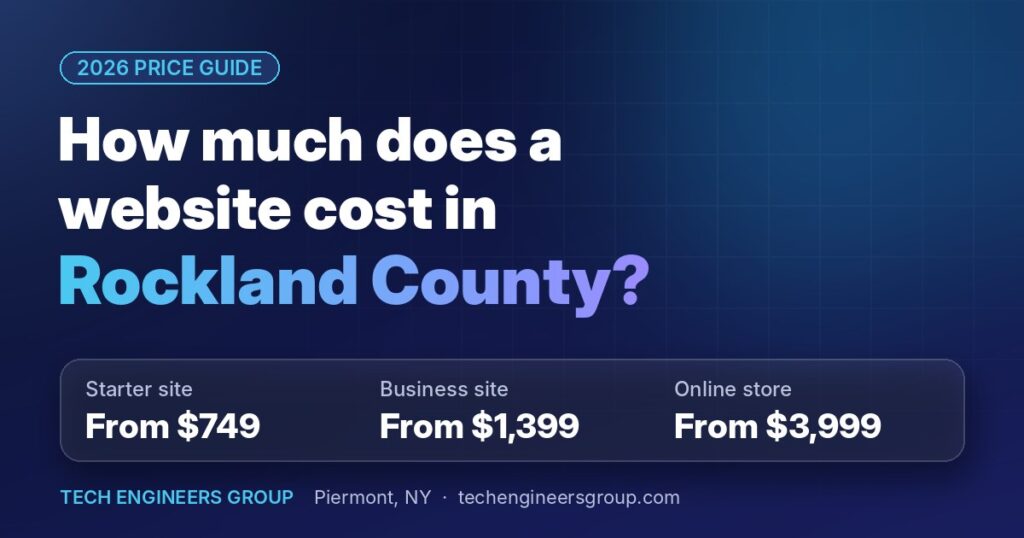
At Tech Engineers Group, a starter site is $749 for up to five pages, a business site is $1,399 for up to 12 pages with service and town pages, full SEO and call tracking, and an online store starts at $3,999. Most contractors choose the business site because of the separate service and town pages. Every project gets a fixed written quote within one business day, and you own the website, domain and content. For a wider look at local pricing, see website costs in Rockland County and website costs in Westchester County.
Tell us your trade, the towns you serve and what your current site is missing. We send a fixed website quote within one business day.
Common contractor website mistakes
- A phone number that is not clickable on mobile.
- One “Services” page that lists everything instead of a page for each service.
- Stock photos instead of your own team, trucks and jobs.
- A contact form that quietly stopped sending emails. Test yours every month.
- The developer owns your domain or hosting account, so you cannot leave.
- Different phone numbers or hours on the website, Google and Yelp.
How to choose a web designer for your contracting business
Ask any web designer, including us, these questions before you sign:
- Can I see two or three live sites you built for contractors or home service businesses?
- Is the price fixed, and what exactly is included?
- Will I own the domain, hosting and website?
- How will the site help me show up on Google Maps for my towns?
- What does support cost after launch?
If you want to see how we approach it, take a look at our website development service.
Frequently asked questions
How much does a website cost for a contractor in Rockland or Westchester?
At Tech Engineers Group a starter site is $749, a business site with service and town pages is $1,399, and an online store starts at $3,999. Most contractors and home service businesses need the business site, because one page per service and per town is what gets them found for searches like “water heater repair Nyack”.
What pages does a contractor website need?
A home page, one page for each main service, pages for the towns you really serve, a reviews or project gallery page, an about page with your license and insurance details, and a short quote or contact page. Every page should have a tap-to-call button on mobile.
How long does it take to build a contractor website?
Most sites launch in one to two weeks once we have your services, towns, photos and logo. Larger sites with many services or an online store can take a little longer.
Will a new website get me more calls from Google Maps?
A website helps, but Google Maps rankings also depend on your Google Business Profile, your reviews and how consistent your business details are across the web. We set up the website so it supports all of those, but nobody can honestly guarantee a Maps position.
Should I use Wix or Squarespace for my contracting business?
A DIY builder can work if you only need a simple online business card. If you want to rank for each service and town you cover, track calls and keep the site fast on phones, a custom WordPress site gives you more control and you own it outright.
Where can I find a web designer for contractors near me?
If you are in Rockland, Westchester or Bergen County, we are based at 393 Piermont Ave in Piermont, NY and meet contractors in person or by video. Whoever you talk to, ask to see live sites they built for home service businesses and get a fixed written quote before any work starts.
Do you only work with contractors in Rockland and Westchester?
No. We are based in Piermont, NY and work with home service businesses across Rockland, Westchester, Bergen County, Long Island and New York City, mostly by video with on-site visits when a project needs one.