When a homeowner in Westchester asks ChatGPT “who should I call for a furnace that won’t start,” the answer names two or three HVAC companies, gives a reason for each, and often includes a phone number. GEO, generative engine optimization, is the work of becoming one of those names. This guide covers the prompts HVAC customers actually ask, what the answers look like today, seven fixes written in HVAC terms, a 30-day plan and what it costs.
Key takeaways
- AI assistants search the web live, read your Google Business Profile, your website and your reviews, and name the companies they can describe with confidence.
- HVAC prompts cluster into five types: emergency, replacement cost, maintenance plans, “best near me” and brand or equipment questions. Each needs a page or a review pattern that answers it.
- The seven fixes are mostly free: profile completeness, specific reviews, one page per service, seasonal pages, town pages, schema, and consistent business data.
- Most contractors that do the foundation work start appearing in some AI answers within four to eight weeks; competitive county-level prompts take longer.
The five prompts HVAC customers ask AI
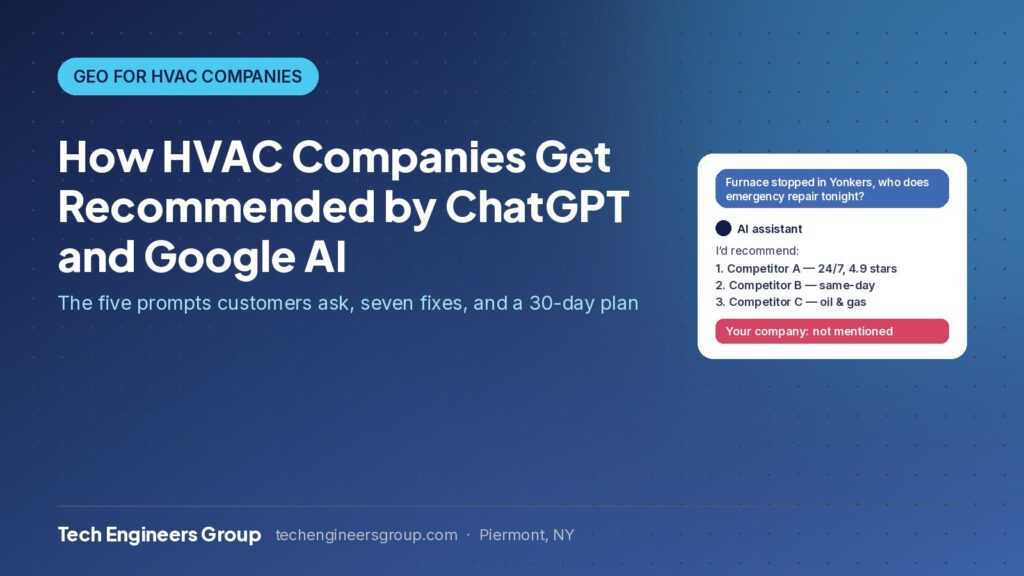
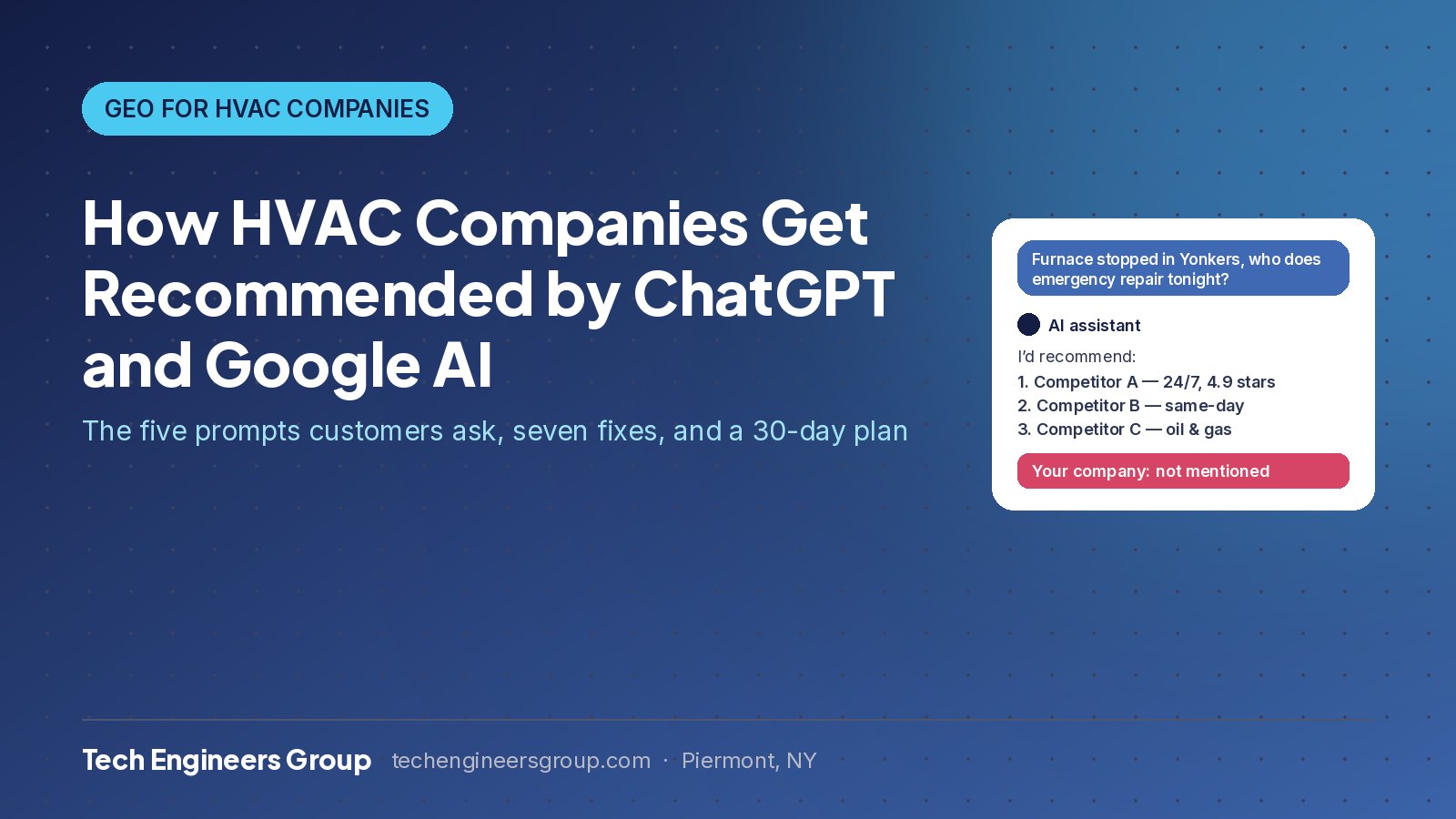
- Emergency: “Furnace stopped working in Yonkers, who does emergency repair tonight?” The model looks for 24/7 or same-day language on your site and in reviews, plus hours on the Business Profile.
- Replacement cost: “How much does a new central AC cost in Westchester County?” It looks for a page with a real price range and the factors that move it. Companies with a cost page get cited; companies that say “call for a quote” do not.
- Maintenance plans: “Is an HVAC maintenance plan worth it, and who offers one near White Plains?” It looks for a dedicated plan page with what is included and the price.
- Best near me: “Who is the best HVAC company in Rockland County?” It cross-checks reviews, listings and third-party mentions, then names the companies that agree with themselves everywhere.
- Brand and equipment: “Who installs Mitsubishi mini-splits in New Rochelle?” or “Carrier dealer near me.” It looks for brand pages and manufacturer dealer listings.
Run these five in ChatGPT and Google AI Mode for your own towns. If you are not named, the reasons the model gives for the companies it does name are your to-do list.
What the answers look like today
In most New York suburbs the same three or four HVAC companies appear across prompts, and they are rarely the biggest. They are the ones whose website says in plain words what they do and where, whose reviews mention “boiler,” “mini-split” or “AC install” alongside a town, and whose business details match on Google, Yelp and their own site. Size and ad spend matter less than clarity and consistency.
Seven fixes, in HVAC terms
1. Finish the Google Business Profile
Primary category “HVAC contractor,” secondary categories for heating, air conditioning and furnace repair. List every service with a from-price: AC repair, furnace repair, boiler repair, heat pump and mini-split installation, duct cleaning, maintenance plan. Add the towns you serve, post a weekly job photo with the town in the caption, and seed the Q&A with “Do you offer emergency service?” and “Do you service oil boilers?”
2. Get reviews that say the job and the town
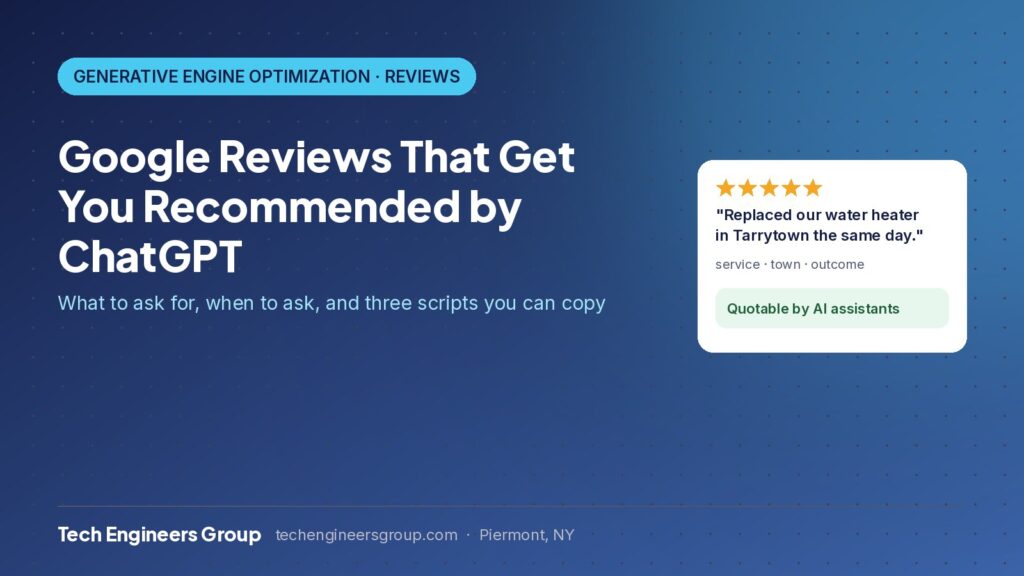
Ask at the end of the call and text the link the same day: “Thanks for having us out for the furnace repair in Scarsdale today.” Reply to every review and repeat the job and town. Our guide to reviews that get you recommended by ChatGPT has the scripts.
3. One page per service
AC repair, AC installation, furnace repair, furnace replacement, boiler service, heat pumps and mini-splits, duct work, maintenance plans. Each page opens with one sentence saying the service, the area and who it is for, then price range, process, FAQs and a form.
4. Seasonal pages that stay up
A “no heat” emergency page and an “AC not cooling” page, live year-round, with the current-season one linked from the homepage. These match the exact wording of emergency prompts.
5. Town pages with real detail
Westchester, Rockland, Long Island and the towns where you do the most work: housing stock (pre-war radiators in Yonkers, split-levels in Nanuet), common systems, permit notes, a review from that town, travel time from your shop. A find-and-replace town page does not count. See how we structure HVAC marketing in Westchester.
6. Schema markup
HVACBusiness (a LocalBusiness subtype) with name, address, phone, hours, service area and a sameAs list of your profiles; Service markup on each service page; FAQPage on pages with FAQs. Validate it; blank fields are worse than none.
7. Identical business data everywhere
Name, address, phone and hours on your site, Google, Bing Places, Apple Business Connect, Yelp, Angi, HomeAdvisor, the BBB and manufacturer dealer locators. One old phone number on a dealer locator is enough to make the model hedge.
Tell us your towns and services. We test the real prompts, show you who is named today, and send a fixed quote within one business day.
Local Services Ads and AI answers
Google’s Local Services Ads still sit above everything for “HVAC near me” searches, and AI Mode frequently pulls Google-Guaranteed businesses into its suggestions. If you qualify, keep LSAs running; they feed the same trust signals (background check, reviews, responsiveness) that the AI reads. Treat GEO as the organic layer underneath, not a replacement.
A 30-day plan
- Week 1: Run the five prompts for your three main towns and log who is named. Finish the Business Profile and fix business-data mismatches.
- Week 2: Rewrite the first paragraph of every service page and add five FAQs to each. Add schema.
- Week 3: Publish the no-heat and AC-not-cooling pages and your top two town pages with real local detail.
- Week 4: Start the review ask on every completed job. Re-run the five prompts and compare.
What GEO costs for an HVAC company
Done in-house, the fixes above are mostly time: a few evenings over a month. Done by an agency, an AI visibility audit and setup typically runs in the low-to-mid hundreds to low thousands, and ongoing plans with monthly AI-mention tracking a few hundred to a couple of thousand dollars a month depending on how many towns and services you compete in. Our GEO cost guide has the ranges, and our HVAC plans start at $499 a month with no contract.
Where to start
If you do one thing this week, run the five prompts and read the reasons. If you want us to run them for you, the free AI visibility check takes two minutes and the full report includes the prompts we tested, who was named and the three fixes that matter most for your company. Details of what we do for contractors are on our HVAC marketing page and our GEO services page.
Frequently asked questions
Does GEO replace Local Services Ads or Google Maps SEO for HVAC companies?
No. LSAs and the map pack still capture most emergency searches. GEO is the layer that gets you named in AI answers, and it reuses the same profile, reviews and pages, so the work overlaps.
How long before an HVAC company shows up in ChatGPT answers?
Contractors that complete the profile, fix business data and add service pages with FAQs usually appear in some AI answers within four to eight weeks. Being named first for county-level ‘best’ prompts depends on reviews and third-party mentions accumulating over several months.
Do I need a separate page for every HVAC service?
Yes for the services you want to be found for: AC repair, AC installation, furnace repair and replacement, boiler service, heat pumps and mini-splits, maintenance plans. One combined Services page is a weak match for all of them.
Should I publish prices on my HVAC website?
A range with the factors that change it (system size, efficiency, ductwork, access) is enough. Cost questions are among the most common AI prompts, and pages that answer them get cited as sources.
What does GEO cost for an HVAC contractor?
An audit and setup typically runs in the hundreds to low thousands; ongoing plans with monthly AI-mention tracking run a few hundred to a couple of thousand dollars a month depending on the number of towns and services. Tech Engineers Group’s HVAC plans start at $499 a month with no contract.